Enterprise Software Is How AI Will Thrive
OpenAI and Anthropic are valued in the trillions and spending hundreds of billions on compute. Chat apps and fun pictures bring in real revenue, but the biggest return on that investment will come from agents doing real work inside enterprise software.

I have worked in the Finance and Spend Management space for 18 years. Today I am a Senior Product Manager at SAP, where I lead the AI & Process Automation focus area for SAP Business Technology Platform (BTP), developing services for SAP Success Plans, the tiered subscription SAP introduced in 2026 to help customers adopt AI-driven innovation and get continuous value from their investment. There is no doubt about it, AI is a powerful technology. I speak with experts in integration, application development and data modeling frequently, and they all agree that AI has cut work that would have taken months or weeks to days or even hours. The speed at which we can work is astounding; moving things from idea to proof of concept is a matter of prompts. Pair that with technical aptitude and small amounts of time you have just accelerated business commerce at SAP. This is all made possible because of Large Language Models and the Front Runners, also known as Frontier Models, are leading the charge.
Frontier Models
OpenAI recently released one of the most powerful frontier models, called GPT-6 Astra,1 a direct competitor to Anthropic’s Mythos-class model, Claude Fable 5.1.2 The United States government was so concerned about the original Fable 5 release that days after its June release, the Commerce Department issued an export control directive and Anthropic suspend access for all customers.3,4 Access was restored on July 1 after the controls were lifted.5
Both models are powerful, but they’re expensive to use. As a result both companies now offer a more affordable option. OpenAI has GPT-6.1 Sol, offering near-Astra performance at significantly lower API costs.6 In addition, Anthropic has Claude Opus 5.5, a model that promises lower cost with similar power.7,8 The main reason is that for LLMs to be profitable they must be practical and affordable and its at this point we experience the tension. Are LLMs currently profitable?
Anthropic
Anthropic is preparing for an IPO that could value it at more than $2 trillion,9 exceeding the $1.77 trillion valuation SpaceX had at its IPO in June.10 Does this valuation hold up to scrutiny?
Anthropic’s IPO filing reportedly shows it plans to commit roughly $518 billion over the coming years to cloud, compute and data center infrastructure, with $7.33 billion spent in 2025 alone.9 Revenue grew twelvefold in 2025 to nearly $4.6 billion, but operating losses also widened to more than $8 billion. The company reported a net loss approaching $42 billion, although roughly $34 billion of that came from an accounting charge tied to financing instruments rather than the cost of operating the business.23
The financial risk is not limited to infrastructure spending. Anthropic routed approximately 47% of its 2025 revenue through Amazon and Google, while two unnamed customers each represented 12% of total revenue. Many of its largest customers are also not committed under long-term contracts. At the same time, Amazon and Google are investors in Anthropic, major suppliers of the computing infrastructure needed to operate Claude, distribution partners selling Claude to customers and direct competitors in AI. Anthropic itself acknowledges that these relationships create potential conflicts and risks around access to compute.24 This type of relationship is not unique. Netflix has relied heavily on Amazon Web Services for more than a decade despite competing directly with Amazon Prime Video. Netflix began moving its technology infrastructure to AWS in 2008 and completed that migration in 2016, demonstrating that a company can depend on a competitor for critical infrastructure while continuing to compete with it at the application and customer level.
There is, however, a significant counterargument. Anthropic’s growth has been remarkable. By April 2026, the company said its annualized revenue run rate had surpassed $30 billion, up from approximately $9 billion at the end of 2025, and more than 1,000 business customers were each spending at least $1 million annually.25 If that growth continues, today’s enormous infrastructure commitments may ultimately look more reasonable. But at a potential valuation above $2 trillion, investors are effectively betting that Anthropic can convert that explosive adoption into durable margins before the cost of delivering frontier AI overwhelms the economics.
OpenAI
OpenAI is seeking new funding at a valuation of roughly $1.4 trillion,11 which would put it alongside Anthropic and SpaceX as one of the most valuable private companies in history. OpenAI has an annualized revenue run rate approaching $70 billion,12 but does this valuation hold up to scrutiny? OpenAI’s own projections reportedly show nearly $280 billion in negative free cash flow between 2026 and 2030, with an astounding $856 billion going to computing power and infrastructure over the same period.13 OpenAI has already signed a computing deal with Oracle worth roughly $300 billion14 and is a central partner in Stargate, a data center initiative of up to $500 billion.15
There are also questions about leadership and governance at OpenAI. A number of senior leaders have left the company, including co-founder and chief scientist Ilya Sutskever, CTO Mira Murati, Chief Research Officer Bob McGrew, VP of Research Barret Zoph and co-founder John Schulman.16,17 This came after the 2023 governance crisis when the board removed Sam Altman and then reinstated him days later.18,19 One additional variable is that newly hired Chief Revenue Officer Denise Dresser, formerly CEO of Slack, left after only eight months in the role.27 None of this proves OpenAI is in financial trouble, but with the amount of cash it is burning and its IPO now pushed back to 2027,20 investors have more risk to weigh when deciding if a valuation over a trillion dollars is justified. The timing of some of these departures is also noteworthy because senior executives with significant equity can have substantial financial incentives to remain through an IPO, although individual compensation and vesting arrangements are not public. The counterargument is that OpenAI is already moving aggressively toward the enterprise and public sector, with more than 40% of its revenue now coming from enterprise customers, a dedicated deployment business, governmentwide procurement agreements, and a deep infrastructure partnership with Oracle through Stargate.
Interpretation
The challenge extends beyond OpenAI and Anthropic. Bain & Company estimates that the global AI industry may need to generate roughly $6 trillion in annual revenue by 2031 to economically justify the infrastructure now being built. Existing consumer and enterprise AI applications may account for only about $1.8 trillion of that amount, leaving roughly $4.2 trillion in new annual revenue that still needs to emerge.26 This is ultimately the question underneath today’s trillion-dollar valuations: not whether AI is useful, but whether it can create enough recurring economic value to pay for the infrastructure required to deliver it.
My interpretation is that the current level of spending is not sustainable indefinitely. OpenAI and Anthropic may be able to support it during a period of exceptional capital formation, but eventually the economics have to change: either revenue and cash flow rise dramatically, the cost of inference falls, or both. That means the frontier labs need to move beyond charging primarily for access to models and toward realistic business models tied to the economic value their systems create. Enterprise agents, workflow automation, software development, integration and decision support are attractive because they can be priced against measurable labor, cycle-time and business outcomes rather than novelty or token consumption alone.
Another pressure is competition from models that do not require frontier-scale infrastructure. Qwen3.8-27B, for example, is an open-weight 27-billion-parameter model that benchmarks competitively with much larger proprietary systems on several coding, reasoning and agentic tasks.28 Quantized versions are also small enough to run on high-end consumer GPUs rather than requiring hyperscale infrastructure.29 That does not make a 27-billion-parameter model equivalent to GPT-6 Astra or Claude Fable 5.1 across every workload, but it does mean enterprises will increasingly have a choice between paying premium frontier-model prices and using smaller, cheaper models that are good enough for a specific task.
I experience this personally, as I run a quantized version of Qwen3.8 on a single RTX 3090 with 24 GB of VRAM and use it to support research with several agents running in the background. That is not a replacement for frontier models when the hardest reasoning or multimodal capability is required, but it demonstrates the economic challenge. But you can’t be the pricetag if you can justify the upfront investment. If useful agentic work can increasingly be performed locally on modest infrastructure, the frontier labs will need to justify their premium through capabilities that materially improve business outcomes, not simply benchmark leadership. In my view, that makes enterprise software and outcome-based monetization not just an opportunity for AI companies, but a necessity.
In Summary
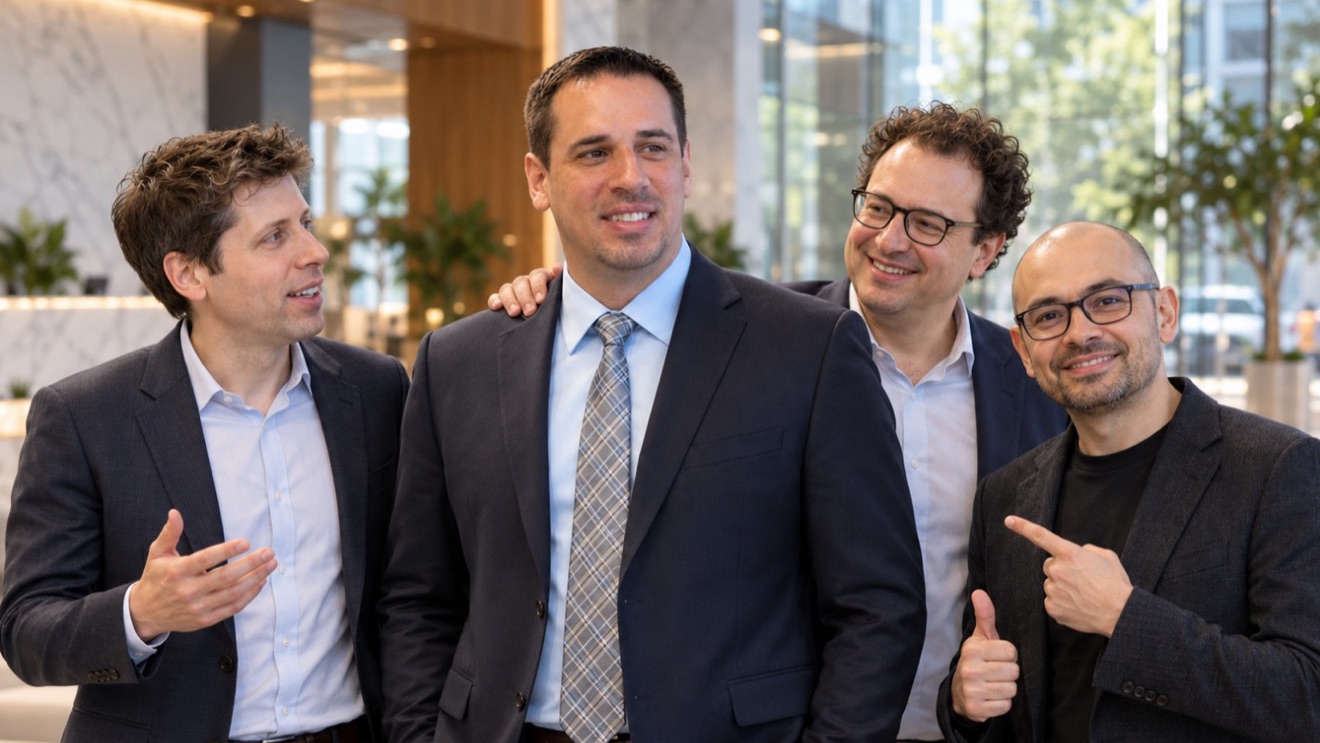
While the picture in my post is fiction, the models and capabilities OpenAI and Anthropic have been releasing are impressive. We can all do fun things with AI, but being able to generate images like this isn’t how AI is going to make money. Enterprise software is how AI will thrive, and SAP’s Autonomous Enterprise strategy is the right approach.21 Embedding agents to facilitate workflows, handle approvals and accelerate software development, integration and automation is where AI will produce positive financial outcomes. Anthropic is tracking this and has announced a $100 million investment in its Claude Frontier Academy, which aims to train 10,000 engineers from partners and enterprise customers to deploy Claude by the end of 2027.22
Sources
- “OpenAI launches Astra, its powerful (and controversial) new model.” TechCrunch, Sept. 3, 2026.
- “Introducing Claude Fable 5.1 and Claude Mythos 5.1.” Anthropic, Sept. 1, 2026.
- “Statement on the directive to suspend Fable 5 access.” Anthropic, June 12, 2026.
- “The Department of Commerce Restricted Access to Anthropic’s Latest Models. What Comes Next?” Center for Strategic and International Studies, June 16, 2026.
- “Redeploying Claude Fable 5.” Anthropic, June 30, 2026.
- “Introducing GPT-6.1 Sol.” OpenAI, Sept. 29, 2026.
- “Claude Opus 5.5.” Claude Platform Docs, Anthropic, accessed Oct. 5, 2026.
- “Introducing Claude Opus 5.5.” Anthropic, Sept. 22, 2026.
- “Anthropic’s $2 trillion IPO comes with a $518 billion bill.” TheStreet, via Yahoo Finance, Oct. 3, 2026.
- “Musk’s SpaceX prices record $75 billion IPO at $135 a share.” Reuters, via Investing.com, June 11, 2026.
- “OpenAI Targets $30 Billion in Funding at $1.4 Trillion Value.” Bloomberg, Sept. 29, 2026.
- “OpenAI’s annual recurring revenue nears $70 billion, Axios reports.” Reuters, Sept. 29, 2026.
- “OpenAI forecasts cash burn near $280 billion by 2030, FT reports.” Reuters, via Investing.com, Sept. 18, 2026.
- “OpenAI, Oracle sign $300 billion computing deal, WSJ reports.” Reuters, Sept. 10, 2025.
- “Microsoft relaxes data center grip on OpenAI amid $500 bln joint venture.” Reuters, Jan. 22, 2025.
- “OpenAI’s technology chief Mira Murati, two other research executives to leave.” Reuters, Sept. 25, 2024.
- “OpenAI’s chief research officer has left following CTO Mira Murati’s exit.” TechCrunch, Sept. 25, 2024.
- “OpenAI CEO Sam Altman to step down.” Investing.com, Nov. 17, 2023.
- “OpenAI reinstates Sam Altman as its chief executive.” NPR, Nov. 22, 2023.
- “OpenAI CEO Sam Altman Says IPO Won’t Be Until 2027 Due to AI Safety Concerns.” Bloomberg, Sept. 12, 2026.
- “SAP Unveils the Autonomous Enterprise.” SAP News Center, May 12, 2026.
- “Anthropic invests $100 million to train 10,000 engineers and tackle the enterprise AI talent gap.” Anthropic, Oct. 2, 2026.
- “Inside Anthropic’s confidential S-1: a Q&A” Reuters, Sept. 30, 2026.
- “Anthropic IPO prospectus lays bare deep dependence on Big Tech partners” Reuters, Sept. 29, 2026.
- “Anthropic expands partnership with Google and Broadcom for multiple gigawatts of next-generation compute” Anthropic, Apr. 6, 2026.
- “AI Faces $6 Trillion Test to Justify Data Centers, Bain Says” Bloomberg, Sept. 28, 2026.
- “OpenAI Replaces Its Chief Revenue Officer with Wiz President” The Information, Aug. 13, 2026.
- “Qwen/Qwen3.8-27B” Hugging Face, accessed Oct. 6, 2026.
- “Benchmarking Qwen 3.8 27B on RTX 5090 and beyond — VRAM capacity alone can’t overcome severe software and inference engine bottlenecks” Tom’s Hardware, Sept. 8, 2026.
- The next phase of enterprise AI | OpenAI OpenAI,